Memory Foam vs Pocket Sprung Mattress: Which Is Best?
Memory foam moulds closely to your body and soaks up movement, so it’s great for pressure relief and light sleepers. Pocket springs feel bouncier, sleep cooler and are easier to move around on. Neither is “better”: the right one depends on how you sleep, whether you run hot, and whether you share the bed. And if you can’t decide, a hybrid gives you a bit of both.
How memory foam feels
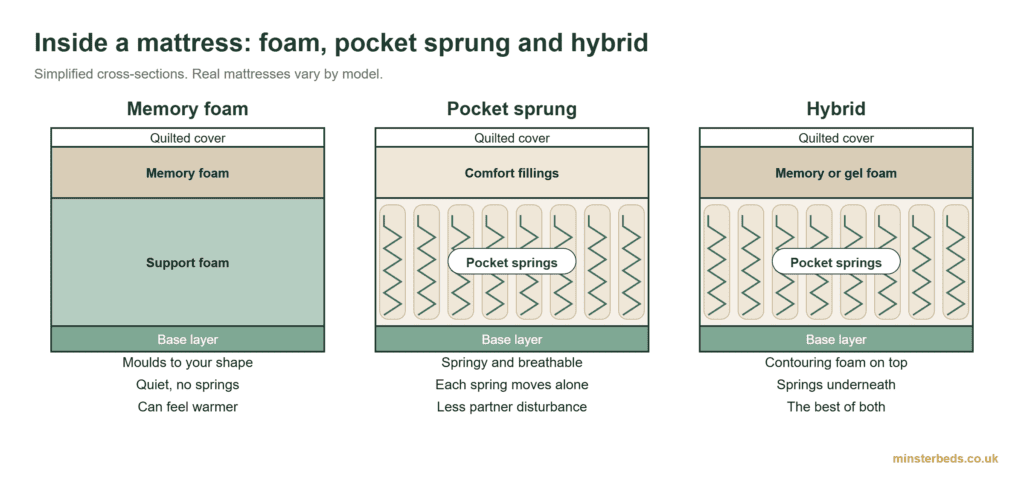
Memory foam softens with your body heat and sinks gently around your shoulders and hips. That “hugged” feeling spreads your weight evenly, which takes pressure off joints. It’s also silent, with no springs to creak, and absorbs movement well.
The trade-offs: it can feel warmer than springs, and it’s slower to bounce back, so some people feel a bit “stuck” when they change position.
In our range: the Postureflex Crystal Memory (2.5 cm of memory foam on 22.5 cm of support foam) and the Diamond Jubilee (5 cm of memory foam on 20 cm of reflex foam).
How pocket springs feel
In a pocket-sprung mattress, every spring sits in its own fabric pocket and moves independently. You get a responsive, slightly bouncy feel, with support that adjusts to each part of your body. Air flows easily between the springs, so they tend to sleep cooler, and it’s easy to roll over.
The trade-offs: they’re usually heavier, and the comfort depends a lot on the fillings on top and how many springs there are. Our spring counts guide explains what the numbers mean.
In our range: the Baker & Wells Excellence 1000 (1000 pocket springs with a pillow top, medium-firm).
Side-by-side comparison
| Memory foam | Pocket sprung | |
|---|---|---|
| Feel | Sinks in and contours to your shape | Bouncier, more “on top of” the mattress |
| Pressure relief | Excellent | Very good, depending on fillings |
| Temperature | Can feel warmer | Usually cooler and more breathable |
| Partner movement | Absorbs it very well | Good, as each spring moves on its own |
| Moving around | Slower to respond | Easy to change position |
| Noise | Silent | Very quiet when well made |
| Weight | Lighter, often rolled for delivery | Heavier |
Which should you choose?
- Side sleepers often love memory foam for the way it cushions shoulders and hips. See our side sleeper guide.
- Hot sleepers usually do better on pocket springs, or on gel-infused foam. See our guide for hot sleepers.
- Couples do well on either, as both cut down partner disturbance. See our couples guide.
- Combination sleepers who change position a lot tend to prefer the easy movement of springs.
The best of both: hybrids
A hybrid puts a layer of memory foam on top of pocket springs, so you get the contouring comfort of foam with the support and airflow of springs. The SleepSoul Balance 800, Baker & Wells Majestic 1000 and Imperial 2500 are all hybrids. Read more in our guide What is a hybrid mattress?


FAQs
Is memory foam or pocket sprung better for back pain?
Either can work well. What matters most is the right firmness for your weight and sleeping position. Our firmness guide can help.
Does memory foam get hot?
Traditional memory foam can feel warmer than springs. Gel-infused foams and breathable covers help, and hybrids add airflow from the springs underneath.
Which lasts longer?
Quality pocket-sprung and hybrid mattresses typically last 8–10 years, and good memory foam 7–10 years. See how long mattresses last.
Related guides: What is a hybrid mattress? · Pocket spring counts explained · Mattresses without springs